For nearly three decades, the reason Cutler Bay traded for less than Palmetto Bay or Pinecrest was simple enough to say out loud: it took longer to get anywhere from there. The busway that ran through town since 1997 helped, but it shared traffic patterns with a corridor that could feel endless at rush hour. On October 27, 2025, that changed. Miami-Dade County flipped the switch on Metro Express, an all-electric bus rapid transit line running in dedicated lanes along the South Dade TransitWay, connecting Cutler Bay directly to the Dadeland South Metrorail station. Less than a year later, the comps still look like the commute never changed.
That gap between what happened on the ground and what shows up in the pricing data is worth sitting with, because it tells you something about where value in Cutler Bay is likely to move next, and it explains a pricing pattern that looks contradictory on its surface.
The number that doesn't match the story
Look at three sources covering Cutler Bay in 2026 and you get three slightly different pictures, which is itself useful information.
| Source | Time window | Median price | Price per sq ft | Days on market |
|---|---|---|---|---|
| Homes.com | Trailing 12 months through mid-2026 | $584,000 sale price, up 1% year over year | Not reported | 85 days |
| Redfin | March 2026 | $578,000 sale price, down 5.3% year over year | $324, down 5.0% year over year | 78 days, down from 91 |
| Movoto | July 2026 | $555,000 list price, down 3% year over year | $318 per sq ft | 36 days, down 33% year over year |
The sources disagree on exactly how fast homes are moving, and that disagreement is normal across different data pulls and methodologies. What they agree on is more interesting: the price a buyer pays per square foot has been softening even as the headline median has stayed roughly flat or ticked up slightly. That combination usually means one thing. Buyers aren't paying less for the same house. They're buying a different mix of house, one where the composition of what's changing hands is skewing toward larger, often older homes that carry a lower cost per square foot than newer, smaller product.
That mix shift matters for this story specifically, because the housing stock that fits that description sits in exactly the part of town where the new transit line runs.
What actually changed on October 27, 2025
Metro Express replaced the old South Dade TransitWay bus service with a rebuilt corridor featuring 14 stations, level boarding, real-time arrival displays, and gate arms at roadway intersections that give buses signal priority over car traffic. The buses themselves are electric, and the route runs the full 20 miles from a park-and-ride in Florida City to the Dadeland South Metrorail station, threading through Homestead, Cutler Bay, Palmetto Bay, and Pinecrest along the way. One of the stations serving the corridor near Cutler Bay is the Caribbean Boulevard station. Construction on the final piece of the project, the SW 296th Street station, wrapped in mid-June 2026, which means the corridor only became fully finished a couple of months before this was written.
The rollout wasn't smooth. The Miami Herald covered a rocky opening, with one frustrated rider summing up the early complaints in three words: "These lights are way too long." Miami Today reported in late December 2025 that the new service was helping commutes along the corridor itself while adding congestion to cross streets in Homestead. Miami-Dade's own transportation department reported that the line was already drawing about 2,500 more weekday riders than the express bus service it replaced, with ridership expected to keep climbing as the kinks got worked out and word spread.
None of that is the kind of detail that shows up in a Zestimate. It's the kind of detail that shows up when someone who's actually watching the corridor tells you what changed and when.
Why the comps take time to catch up
There's a reason this hasn't shown up in Cutler Bay's pricing yet, and it isn't unique to South Florida. The Federal Transit Administration studied Boston's Silver Line bus rapid transit corridor and found that condo sales near the line carried no measurable price premium in 2000 and 2001, before the line opened in 2002. By 2007 and 2009, that premium had grown to roughly 7.6 percent. A separate look at Eugene, Oregon's Emerald Express BRT line found that home values rose by about $1,128 for every 100 meters closer a property sat to a station.
The pattern in both cases is the same. Transit access gets built into home prices gradually, as buyers, appraisers, and eventually sellers start treating proximity to a station as a real amenity rather than a novelty. Less than a year after Metro Express opened, Cutler Bay is roughly where Boston's Silver Line corridor was in its first year. The infrastructure exists. The pricing hasn't absorbed it yet.
Which pockets of Cutler Bay actually sit on the corridor
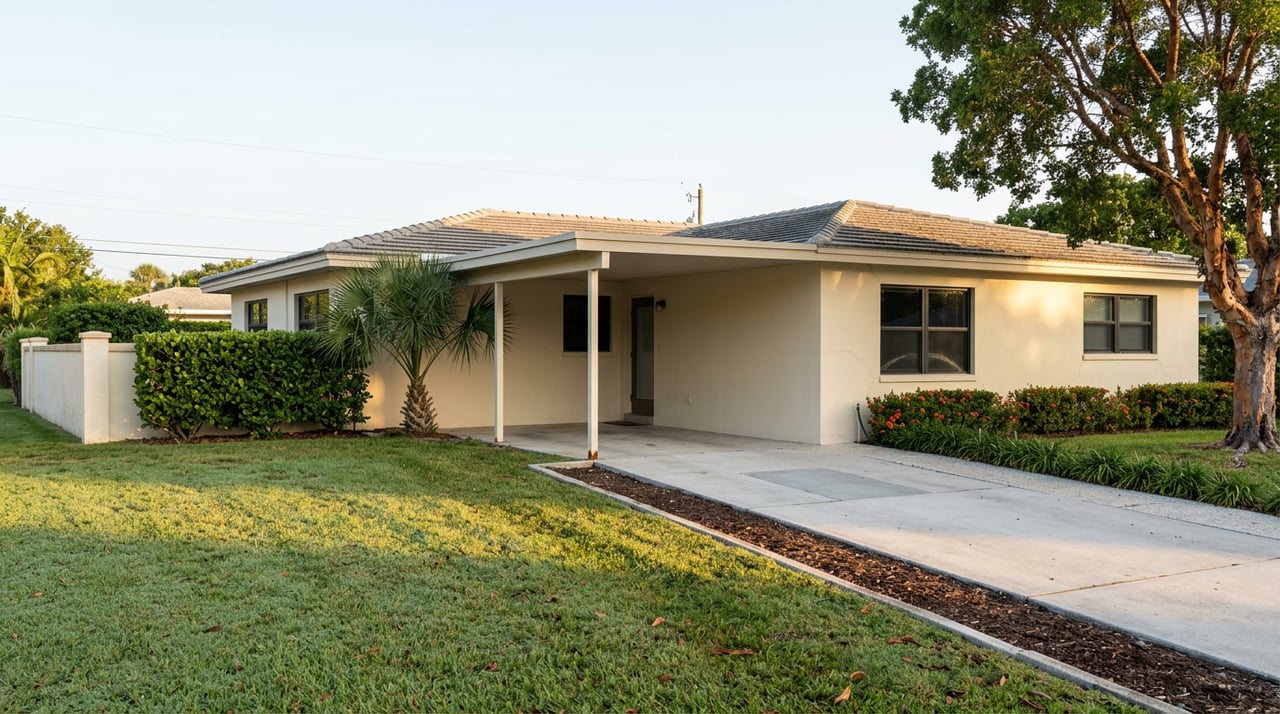
This is where knowing the town street by street matters more than knowing the townwide median. The South Dade TransitWay runs parallel to US-1, which cuts through the older, central and western part of Cutler Bay, an area built out mostly in the 1950s through the 1970s with one-story concrete block homes on larger lots, most of them outside any homeowners association. That's the housing stock closest to stations like Caribbean Boulevard and SW 296th Street.
The newer, more polished part of Cutler Bay sits farther east, closer to Biscayne Bay. Lakes by the Bay is the large master-planned community out there, built in phases around a series of lakes, with newer sections like Isles at Bayshore adding single-family homes, townhouses, and condo buildings from national builders. Cutler Cay, a gated single-family community with clubhouse amenities, and Saga Bay, an established neighborhood near Saga Bay Park with its own lakefront pockets, both sit closer to the water than to a bus platform.
None of that makes one part of town better than the other. It does mean the two halves of Cutler Bay are exposed to this particular shift very differently. The older, non-HOA sections near the corridor are the ones absorbing the current wave of demand for larger, lower-price-per-square-foot homes, and they're also the ones sitting closest to a transit amenity that national data suggests takes years to fully price in.
What this means if you're buying or selling near a station
A few things worth checking before treating any Cutler Bay listing as generic inventory:
- Measure actual distance to a station, not just "near the busway." The BRT research cited above shows the value effect concentrates within a few hundred meters of a platform, not a general neighborhood.
- Ask whether the home carries a mandatory HOA or CDD assessment. The eastern master-planned communities typically do. The older central and western sections generally don't, which changes the real monthly cost comparison even between two homes priced similarly.
- Read price-per-square-foot trends, not just the median, when comparing listings. A townwide median can hold steady while the underlying mix quietly shifts toward larger, older product, which is exactly what the 2026 data shows happening.
- Don't expect an instant transit premium to show up in an appraisal. History from other BRT corridors suggests this kind of value shows up over several years, not several months.
A couple of questions worth asking directly
Will Cutler Bay home prices go up because of Metro Express? The corridor's own history and comparable BRT lines elsewhere suggest any premium builds gradually rather than appearing overnight. Less than a year in, that process is just getting started.
Is the new transit line actually faster than driving? Dedicated lanes and signal priority at gate-arm intersections are designed to insulate the bus from US-1 traffic, which is a meaningful structural change from the old service. Early rider complaints about signal timing suggest the system is still being tuned, and Miami-Dade has continued adjusting it since the October 2025 launch.
Does this affect every part of Cutler Bay equally? No. The corridor runs through the town's central and western sections. Homes in the eastern master-planned communities near Biscayne Bay sit farther from any station and won't see the same exposure to this particular shift.
If you're weighing a move into Cutler Bay, or trying to figure out whether your own home sits in the part of town this transit change actually touches, that's the kind of block-by-block read worth getting before you price anything. Kelli Farrell has spent close to three decades working these exact streets in South Miami-Dade, and can walk you through what a specific address is worth today, and what it might be worth once the rest of the market catches up. Let's connect.
This article is general information, not legal, tax or financial advice. Consult a qualified professional about your situation.